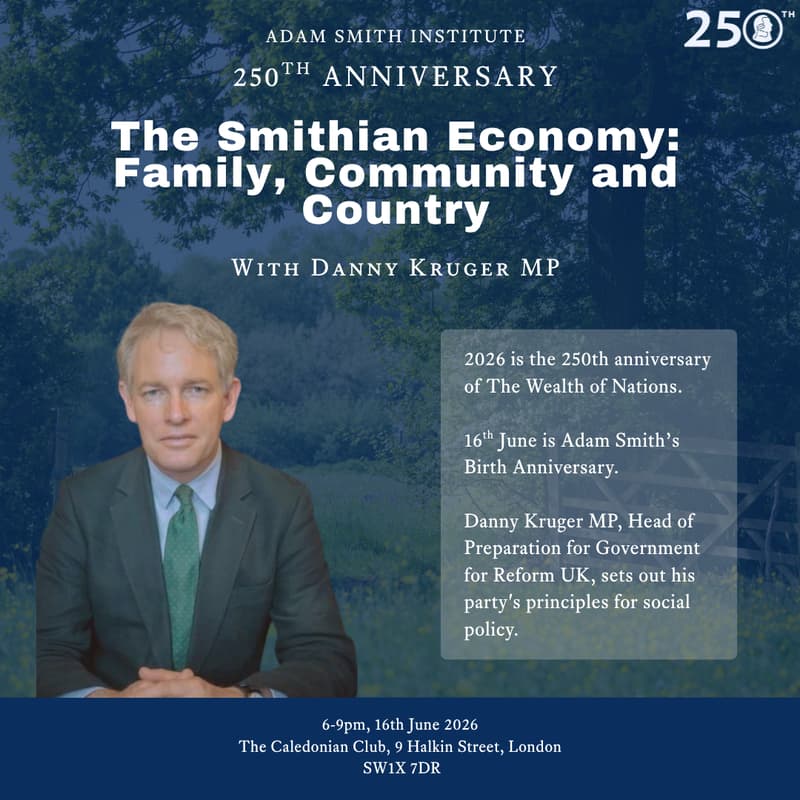

The Smithian Economy: Family, Community and Country
Adam Smith is routinely caricatured as the patron saint of unfettered individualism. This is a misreading. Smith wrote The Theory of Moral Sentiments seventeen years before The Wealth of Nations. He believed that sympathy, moral sentiment, and the bonds of family and community were the foundations on which commerce and liberty rested. His famous critique of the "man of system" - the central planner who moves people around like pieces on a chessboard - was not a defence of atomised selfishness. It was a defence of organic social order against utopian design.
Edmund Burke recognised this immediately. After reading The Theory of Moral Sentiments, he wrote to Smith that he was "not only pleased with the ingenuity of your Theory" but "convinced of its solidity and Truth." Smith later said that Burke was "the only man who, without communication, thought on these topics exactly as he did."
That intellectual kinship runs deeper than personal friendship. Burke's "little platoons" - the family, the parish, the local association - are the social units through which moral sentiments operate. Hayek later developed the same insight into his theory of spontaneous order: that the most resilient and adaptive institutions are not designed from above but emerge from below, through the accumulated wisdom of generations.
This tradition has older roots still. The Spanish Scholastics of the School of Salamanca - theologians like Francisco de Vitoria and Luis de Molina - were articulating the principles of subjective value, just price, and the limits of state power centuries before Smith synthesised them into a system. Free-market economics has Christian and communitarian foundations that long predate the Enlightenment. Smith was the great synthesiser, not the inventor.
250 years on, that synthesis matters more than ever. In much of the world, Smithians, communitarians and Christians are natural allies. Britain faces a crisis of community, family and national cohesion that cannot be solved by the state alone - but nor can it be solved by a market philosophy that ignores the social fabric. The real enemies of community, as Smith understood, are producers capturing state power and top-down bureaucratic plans imposed from above. The question for this lecture is: what does a social policy look like that trusts people, families and communities rather than distant bureaucracies?
Event Details
Date: Tuesday, 16th June 2026
Time: 6:00 PM – 9:00 PM
Venue: The Caledonian Club (9 Halkin Street, London SW1X 7DR)
Keynote Speaker: Danny Kruger MP
Chair: James Lawson, Chairman of the ASI
Dress code: business/club attire (see here)
Agenda
18:00 – 19:00: Drinks Reception
19:00 – 19:05: Introduction by James Lawson
19:05 – 19:40: Keynote Lecture: Danny Kruger MP
19:40 – 20:00: Chaired Q&A
20:00 – 21:00: Drinks Reception