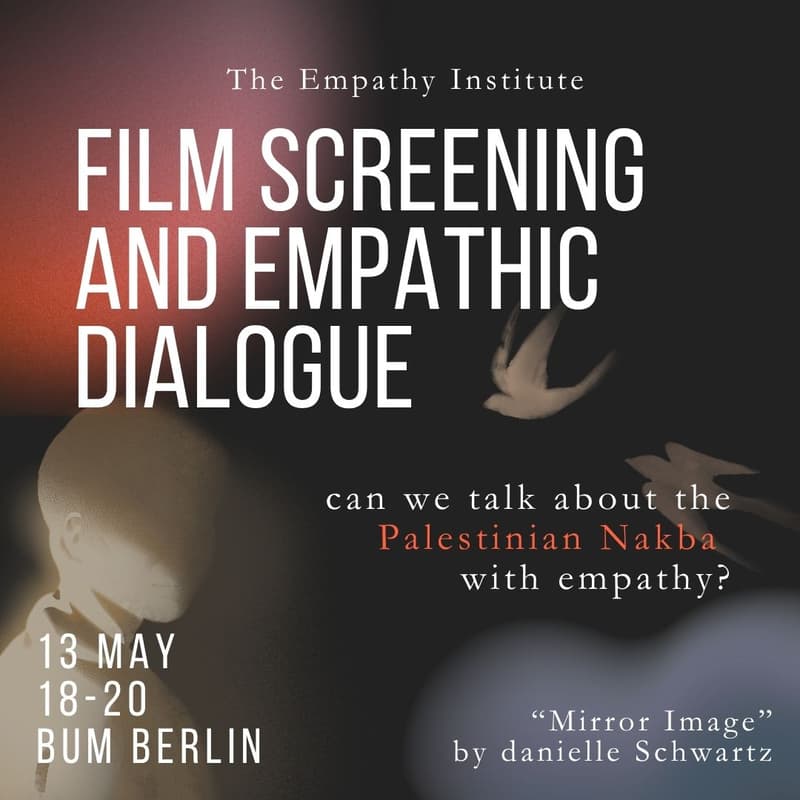


Film Screening and Empathic Dialogue
Can we empathise over polarised topics such as the Palestinian Nakba?
NOTE: the €5 is a deposit, not a price tag.
LIMITED SPOTS: we will cap this event at 30 people to ensure we can hold the space with care and attention.
Who is this for?
People who are tired of conversations that go nowhere and want to try something different
Israelis, Palestinians and activists navigating feelings about the history of the conflict
Those who are simply curious and want to understand more
❗️This event is not about finding solutions or blaming. It is a space to try compassionately listening to one another.
The event is a collaboration between Danielle Schwartz, a filmmaker from Israel, and The Empathy Institute.
We will screen her award-winning 10-minute short film "Mirror Image", in which she interviews her Israeli grandparents about a mirror in their home, an object taken from a Palestinian village during the Nakba in 1948.
Following the screening, we will facilitate a structured dialogue rooted in empathy: giving everyone time to share what arose in them, to be heard without being corrected or debated, and to encounter what others in the room are carrying. There is no right or wrong, only what is true for you, and what is true for someone else.
In a time when most public conversations about this region offer little room for nuance, this evening is a practical demonstration of a different possibility: that we can stay present with difficulty, hold more than one reality at once, and find the shared humanity beneath even our most painful disagreements.
When: 13 May 18:00-20:00 (please arrive on time, doors close at 18:15)
Where: bUm Berlin, Paul-Lincke-Ufer 21
To secure your spot, we ask for a €5 deposit, which will be refunded at the event. This is to ensure a room full of people who genuinely want to be there. Additionally, we will also be accepting donations the night of, if the desire to contribute something to our work comes up.
About The Empathy Institute:
In a world full of disconnection and polarisation, we offer an alternative: instead of louder arguments, we show the benefits of deeper listening, especially when we disagree.
Follow us: